Best Tape Measure For Carpentry (2026)

About the author
The one-measure moment that ruins a cut list
You measure a stud bay, mark your cut, and everything looks fine—until the piece lands 1/8″ short and the gap telegraphs through the trim. Or you’re laying out a run of blocking and one “close enough” measurement stacks up into a crooked line. In carpentry, small measuring errors don’t stay small.
That’s why the best tape measure for carpentry isn’t about fancy features. It’s about a tape that’s easy to read, tough enough for jobsite drops, and consistent when you hook, pull, and re-check all day.
A good carpenter tape measure saves time because you trust it. So you stop second-guessing every mark.
On this page, I’m breaking down 5 proven tape measures for 2026. They’re picked for real carpentry needs like standout, blade durability, hook reliability, and “does it survive getting tossed in a pouch.”
Disclosure: As an Amazon Associate, ToolLayout may earn from qualifying purchases. This doesn’t change what we recommend.
Quick take: what matters most in a carpenter tape
This page compares 5 jobsite-ready styles. We’re focused on the stuff that actually affects your cuts and layout:
- Durable tape measure builds for daily carry (pouch, ladder, truck)
- Impact resistant tape measure options that handle drops and rough handling
- Fast readability for cut lists, layout, and quick checks
Best Tape Measure for Carpentry (2026): Top 5 Picks
| Image | Product | Best for | Key feature | View on Amazon |
|---|---|---|---|---|
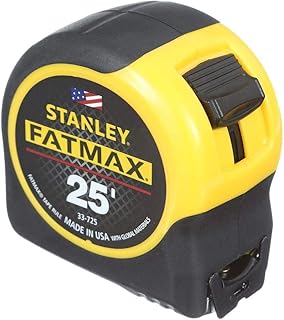 | Stanley FATMAX 33-725 25-Foot Tape Measure | All-around carpentry: framing, trim, and general jobsite work | Thick blade + strong standout feel (a classic “daily carry” carpenter tape) | View on Amazon |
 | Milwaukee 48-22-0225 Compact Tape Measure 25ft | Tool belt carry when you want compact size without feeling flimsy | Compact body that still feels jobsite-tough and easy to handle one-handed | View on Amazon |
 | DEWALT DWHT36107 30-Foot Tape Measure | Longer pulls for layout and rough carpentry where reach matters | 30 ft length for fewer “move the ladder” re-measures on bigger spans | View on Amazon |
 | Komelon SL2825 Self Lock 25-Foot Tape Measure | Fast one-handed measuring when you like a self-locking blade | Self-lock mechanism (blade stays out until you hit the button) | View on Amazon |
 | Stanley PowerLock 33-425 25-Foot Tape Measure | Budget-friendly backup tape for the truck, shop, or occasional use | Simple, proven design that’s easy to replace and easy to read | View on Amazon |
1) Stanley FATMAX 33-725 25-Foot Tape Measure — Best overall tape measure for carpentry (daily jobsite use)
A classic carpenter tape that balances standout, readability, and jobsite toughness.
Watch for: Keep the hook screws clean. Packed grit can make any tape feel “inaccurate” on inside/outside measurements.
Best for: framing, trim work, and general carpentry where you want one tape that just works
What you’ll like: thick blade feel + easy-to-read markings when you’re moving fast
🧐 Quick verdict: The most “grab it every day” tape—tough, readable, and dependable for typical carpentry pulls.
| Pros ✅ | Cons ⚠️ |
|---|---|
| ✅ Great all-around balance of standout, durability, and readability | ⚠️ Like any tape, it’s only “accurate” if the hook stays clean and undamaged |
| ✅ Strong choice for a durable tape measure that lives in a pouch | |
| ✅ Easy to trust for quick cut-list work and layout |
Why it’s a top pick: For carpentry, you want a tape that’s stiff enough for solo measuring, readable enough to reduce “double-check fatigue,” and tough enough to survive drops. This model is a common “default” on jobsites because it keeps things simple.
Decision bullets: Stanley FATMAX
- Readability: Clear markings for fast cut-list work. If you bounce between layout lines and saw cuts, this matters.
- Standout: Stiffer blade helps for solo measuring across studs, sheet goods, and openings.
- Hook behavior: The hook is designed to move slightly (that’s normal) to account for inside vs outside measurements. Keep it clean, and don’t bend it.
- Jobsite durability: A solid choice when your tape lives in a pouch, gets dropped, and gets used with dusty hands.
- Best for: One-tape solution for most carpentry tasks.
Shop tip: If your measurements feel “off,” check hook play and technique before blaming the tape. Quick walkthrough: [GUIDE:/tape-measure-accuracy-tips/]
2) Milwaukee 48-22-0225 Compact Tape Measure 25ft — Best compact tape measure for carpentry belt carry
A solid pick when you want a smaller tape that still feels like it belongs on a jobsite.
Watch for: Compact tapes can encourage one-handed measuring. Keep the blade aligned so you don’t “arc” the measurement.
Best for: daily pouch carry, punch-list work, and quick layout checks
What you’ll like: comfortable in-hand size that’s easy to grab, clip, and use all day
🧐 Quick verdict: Best when you want a compact tape that doesn’t feel like a toy—easy to carry, easy to use.
| Pros ✅ | Cons ⚠️ |
|---|---|
| ✅ Compact size is great for belt carry and ladder work | ⚠️ Compact tapes can be harder to control on long, solo pulls |
| ✅ Comfortable for quick “measure-mark-cut” cycles | |
| ✅ Good option when you want a jobsite-ready, impact resistant tape measure feel |
If you’re always climbing, stepping around sawhorses, or working out of a pouch, comfort matters. A compact tape can be the difference between “always on me” and “somewhere in the truck.”
Why it’s a top pick: It’s a practical daily-carry option when you want a smaller footprint but still want a jobsite-ready feel.
Decision bullets: Milwaukee Compact
- Best use case: punch-list work, trim days, and quick measuring where you’re constantly moving.
- Control: Keep the blade straight and supported on longer pulls. Otherwise, any tape will “lie” along a bowed path.
- Durability reality: Don’t let grit pack into the case, and wipe the blade if it gets wet.
- Best for: Carpenters who want a smaller tape they’ll actually keep on them.
3) DEWALT DWHT36107 30-Foot Tape Measure — Best tape measure for carpentry layout on longer pulls (framing, decks, bigger spans)
A good pick when 25 ft feels short and you’d rather pull once than re-hook and re-measure.
Watch for: Longer blades can whip on retract. Control the return so you don’t kink the blade or smack the hook.
Best for: longer spans, rough layout, and framing tasks where reach saves time
What you’ll like: 30 ft length reduces “move and re-hook” on bigger work
🧐 Quick verdict: Best when your work regularly pushes past 25 ft—layout goes faster with fewer re-hooks.
| Pros ✅ | Cons ⚠️ |
|---|---|
| ✅ 30 ft length is useful for framing/decks and bigger layout | ⚠️ Bigger tapes add weight on the belt |
| ✅ Fewer re-measures on longer runs | |
| ✅ Good “layout tape” to keep with your framing kit |
If you do decks, fences, room layout, or you’re constantly measuring longer spans, a 30 ft tape can be a real productivity upgrade. It’s not “more accurate,” but it reduces re-hooking and the mistakes that happen when you split one measurement into two.
Why it’s a top pick: The extra length helps you keep layout simple—one pull, one mark, and fewer chances to misread or mis-transfer.
Decision bullets: DEWALT 30 ft
- When to choose 30 ft: if you routinely measure openings, runs, or diagonals where 25 ft forces a reset.
- Technique: Control blade return to prevent kinks. Kinks create permanent “bad spots” on any tape.
- Best for: Longer layout pulls and rough carpentry where reach saves time.
Layout tip: If you’re checking squareness, don’t rely on one diagonal measurement alone. Verify straight references too. Helpful read: [GUIDE:/straight-edge-vs-level-how-to-check-flatness/]
4) Komelon SL2825 Self Lock 25-Foot Tape Measure — Best self-locking tape measure for carpentry speed
A self-locking tape is a workflow choice: pull to your mark and it stays put until you release it.
Watch for: Self-lock tapes can snap back hard if you hit the release. Keep a finger on the blade so you control retract.
Best for: one-handed measuring and repetitive measure/mark cycles
What you’ll like: blade stays extended without constantly holding a lock button
🧐 Quick verdict: Best for speed when you’re measuring solo—pull, read, mark, and move on.
| Pros ✅ | Cons ⚠️ |
|---|---|
| ✅ Self-lock is fast for one-handed measuring | ⚠️ Retract control matters—snap-back can kink blades over time |
| ✅ Easy to hold a measurement while you mark | ⚠️ Not everyone likes the self-lock feel for fine work |
| ✅ Great for repetitive measuring tasks |
Some carpenters love self-locking tapes because they speed up measuring and marking. This is especially true when you work solo and bounce between pieces.
The tape stays where you pull it, so you can mark without juggling the lock. But you still need to control retract to protect the blade.
Why it’s a top pick: It’s a workflow upgrade if you do lots of repetitive measuring. The self-lock feature reduces the “third hand” problem.
Decision bullets: Komelon Self Lock
- Best use case: repeated measuring/marking on studs, blocking, trim pieces, and punch-list tasks.
- Blade care: Control retraction to avoid kinks. Kinks are a bigger accuracy killer than most people realize.
- Best for: Fast one-handed measuring when you like the self-lock style.
Related: When a tape measure isn’t the right tool (and when a steel rule is faster): [GUIDE:/steel-ruler-vs-tape-measure-when-to-use/]
5) Stanley PowerLock 33-425 25-Foot Tape Measure — Best budget backup for the truck or shop
A simple, familiar tape that’s great as a spare or a “keep one in every place” option.
Watch for: Check the hook for damage if it’s been dropped. Budget tapes are still accurate when they’re not bent.
Best for: backup tape in the truck, shop tape, or light carpentry tasks
What you’ll like: straightforward layout and easy reading for basic measuring
🧐 Quick verdict: Best “second tape” to keep nearby—simple, usable, and easy to replace when life happens.
| Pros ✅ | Cons ⚠️ |
|---|---|
| ✅ Great as a backup/shop tape (simple and familiar) | ⚠️ Not the toughest option for daily belt carry on rough sites |
| ✅ Easy to read for basic carpentry measurements | ⚠️ Less “premium” feel on standout and abuse resistance than heavy-duty tapes |
| ✅ Handy to keep in the truck, toolbox, and shop |
Every carpenter ends up needing a spare tape—one for the truck, one for the shop, and one that won’t ruin your day if it disappears for a week. A basic, proven tape is still useful if you keep the hook straight and the blade in good shape.
Why it’s a top pick: It’s a practical “backup plan” tape. When your main tape takes a hit, you can keep working.
Decision bullets: Stanley PowerLock
- Best use case: shop tape, homeowner/occasional carpentry, or a spare in the truck.
- Accuracy reality: Most tape “accuracy problems” come from hook damage, blade kinks, or bad technique—not the printed markings.
- Best for: Keeping a reliable tape within reach without overthinking it.
If you also do fine woodworking, compare with our woodworking-focused picks: Best Tape Measure For Woodworking
How we choose
To recommend a tape that actually holds up in carpentry, we focus on what changes results on a real jobsite:
- Blade stiffness and control (standout and how it behaves on solo pulls)
- Readability (fast to read under bad lighting, awkward angles, and speed)
- Hook reliability (movement is normal; damage is not)
- Durability (drops, grit, wet days, and pouch wear)
- Carpentry workflows (framing, trim, layout, punch-list, and “measure/mark/cut” cycles)
If you want more measuring tool roundups, start here: Measuring Tools hub
Don’t buy the wrong tape measure
Don’t buy this if…
- You need a tape mainly for cabinetmaking/bench work where a steel rule is often faster and more precise for short measurements.
- You constantly work solo on long spans and you pick a tiny, floppy tape. A compact tape is convenient, but it’s not always the best for long pulls.
- You expect “accuracy” while ignoring hook damage, blade kinks, or poor technique. A bent hook will beat any brand name.
Buy this if…
- You want a durable tape measure that survives daily carpentry use—pouch carry, drops, dust, and quick measuring.
- You care about readability and speed because you’re measuring constantly, so mistakes cost time.
- You want an impact resistant tape measure feel for the jobsite (and you’ll still treat the hook and blade with basic care).
Buyer’s guide: how to choose a tape measure that works for carpentry
Start with your “default” length: 25 ft vs 30 ft
For most carpentry, 25 ft is the everyday sweet spot. But go to 30 ft if you regularly do larger layout where re-hooking wastes time and creates mistakes.
- 25 ft: lighter on the belt, great for trim, framing, and general work.
- 30 ft: better for decks, longer runs, and bigger spans—expect more weight.
Readability: the fastest tape is the one you can read instantly
On a jobsite, you often read a tape at an angle, in shadows, or while holding material. Because of that, prioritize bold markings and a blade finish that doesn’t glare.
If you do a lot of short, repeatable measurements, it also helps to know when a steel rule is simply the better tool: [GUIDE:/steel-ruler-vs-tape-measure-when-to-use/]
Hook play: what’s normal vs what’s a problem
The hook is supposed to move slightly to compensate for inside vs outside measurements. The problem starts when the hook is bent, loose, or packed with grit.
- Normal: slight in/out movement.
- Not normal: hook twisted, bent, or visibly loose; blade kinked near the hook.
Quick fixes and accuracy checks: [GUIDE:/tape-measure-accuracy-tips/]
Standout and blade durability (where tapes actually fail)
Standout helps when you measure solo, but blade durability is what keeps your tape usable. Common failure points are kinks, crushed edges, and a hook that’s been yanked sideways.
A simple 3-step measuring routine for repeatable layout
- Hook and align: seat the hook flat and pull straight on the line you care about.
- Read square-on: avoid parallax by looking straight at the mark, not from the side.
- Control retract: guide the blade back so it doesn’t slam and kink.
- For longevity: control retraction—don’t let it slam into the case.
- For accuracy: don’t “arc” the blade; measure along the real line you care about.
- For finish carpentry: mark with a sharp pencil/knife and read from the same viewing angle to avoid parallax.
When you should buy a wide-blade tape
If you’re constantly doing long solo pulls (layout, framing, sheathing), a wider blade can help with standout and control. See the dedicated roundup: Best Wide Blade Tape Measure
Troubleshooting table: problem → cause → fix
| Problem you see | Likely cause | Fix that works in a real shop |
|---|---|---|
| Inside measurements are always “off” | Not using case length correctly; hook packed with grit | Use the case length method consistently; clean the hook area and re-check |
| Outside measurements vary depending on how you pull | Hook is bent/loose; pulling at an angle | Inspect the hook for twist; pull straight in line with the measurement |
| Blade kinks near the hook | Letting the tape snap back; side-loading the hook | Control retract; don’t yank sideways when unhooking from edges |
| Marks don’t match your cut line | Reading from an angle; pencil tip too dull | Read square-on; use a sharp pencil or knife line for finish work |
| Measurements “stack” wrong across multiple pieces | Inconsistent reference points; mixing inside/outside methods | Pick a consistent reference face/edge and stick to one measuring method for the batch |
| Tape feels rough/sticky retracting | Dust/grit in the case; blade contamination | Wipe the blade; blow out the case carefully and avoid storing wet |
| Layout lines drift over distance | Tape not held on the true line; blade arcing | Support the blade, keep it straight, and use a straightedge/chalk line for long layout |
| Stud layout mistakes (16″ o.c.) | Misreading marks; not confirming start point | Confirm the “0” point and crown direction; mark clearly and re-check at 48″ and 96″ |
More accuracy and technique help: [GUIDE:/tape-measure-accuracy-tips/]
Common mistakes and quick wins (shop-pro tips)
Quick wins that instantly improve measuring accuracy
- Check the hook before blaming the tape. A bent hook = bad measurements.
- Pull straight along the line you’re measuring. Don’t measure along an arc.
- Control retraction to prevent kinks and hook damage.
- Use the right tool for short work: a steel rule is often faster and more precise under 12″ (305 mm).
Common mistakes
- Measuring from a damaged hook and “trusting the brand.”
- Letting the blade snap back into the case (kinks are forever).
- Mixing inside and outside measuring methods mid-project.
If you want a woodworking-focused comparison (readability and finer work), see: Best Tape Measure For Woodworking
FAQs
1) What’s the best tape measure for carpentry?
For most carpenters, the best choice is a tough 25 ft tape with a readable blade and a reliable hook. You want something you can use one-handed, trust on quick pulls, and carry every day without babying it.
2) What length tape measure do carpenters use most?
Most carpenters default to 25 ft for daily work. A 30 ft tape is helpful for longer layout, decks, and bigger spans, but it adds weight.
3) Are expensive tapes more accurate?
Not automatically. Accuracy issues usually come from hook damage, blade kinks, or measuring technique. However, a premium tape can be more durable and readable, which helps you stay consistent.
4) Why does the hook move on my tape measure?
That small movement is intentional. It compensates for the hook thickness so inside and outside measurements can both be correct. Problems start when the hook is bent, twisted, or loose.
5) What makes a tape measure “durable” for carpentry?
A durable tape measure holds up through drops, grit, and pouch wear, and the blade resists kinks. The hook staying straight is a big part of real-world durability.
6) What’s the best impact resistant tape measure?
Look for a tape with a tough case design and a blade that resists kinking. Even with an impact resistant tape measure, controlling blade snap-back and protecting the hook will extend life.
7) When should I use a wide-blade tape?
Use a wide-blade tape when you regularly measure solo over longer distances and want more standout and blade control. Roundup here: Best Wide Blade Tape Measure
8) Is a tape measure or a steel rule better for carpentry?
A tape is better for longer measurements and jobsite work. A steel rule is often faster and more precise for short measurements and bench work. More detail: [GUIDE:/steel-ruler-vs-tape-measure-when-to-use/]
9) How do I keep my tape measure accurate?
Keep the hook straight and clean, avoid kinks by controlling retract, and measure along a straight line (no arcing). Practical tips: [GUIDE:/tape-measure-accuracy-tips/]
Conclusion: which tape measure should you buy?
If you want the most useful “one tape” for daily carpentry, go with the Stanley FATMAX 33-725 25 ft (Pick #1) for a dependable mix of standout, readability, and toughness.
If you want a smaller carpenter tape measure that’s easy to carry all day, the Milwaukee Compact 25 ft (Pick #2) is the practical belt option.
For bigger spans and layout, the DEWALT 30 ft (Pick #3) reduces re-hooking and keeps long pulls simpler.
If you like a self-locking workflow for fast one-handed measuring, the Komelon Self Lock (Pick #4) is the style to try.
And if you want a budget-friendly spare for the truck or shop, the Stanley PowerLock (Pick #5) is a solid backup.
Want a woodworking-focused tape list too? Start here: Best Tape Measure For Woodworking