Best Corner Clamping Square For Assembly (2026)

About the author
The one corner that throws off the whole box
You clamp up a cabinet, drawer, or frame and everything looks fine—until you measure corner-to-corner and realize it’s racked. Then you’re racing glue-up time while clamps slide and parts twist.
The fix is simple: use a corner clamping square that holds two parts at 90° while you clamp, screw, nail, or pin. That way, the corner doesn’t shift while you focus on the actual assembly.
If you’re shopping for the best corner clamping square for assembly, this page compares 5 proven options for 2026. The picks match real shop use cases like cabinet boxes, face frames, drawers, and small jigs.
Disclosure: As an Amazon Associate, ToolLayout may earn from qualifying purchases. This doesn’t change what we recommend.
This roundup focuses on what matters at the bench:
- Holding power that resists slipping as clamp pressure ramps up
- Square registration that’s easy to set on an edge and repeat
- Clearance for clamps, screws, brads, and driver access
Quick start: how to use a corner clamping square for assembly
If you want the basics first, start at Squares hub. If you just want the fast workflow, use this simple order:
- Dry-fit the corner and make sure the faces sit flush.
- Clamp the square to one workpiece first, so it can’t rotate.
- Bring the second piece in, then clamp the joint tight.
- Verify with a small square or diagonals, then fasten.
Best corner clamping square for assembly (2026): Top 5 Picks
| Image | Product | Best for | Key feature | View on Amazon |
|---|---|---|---|---|
 | Woodpeckers Clamping Square Plus | Fast, accurate 90° registration for cabinet/drawer assembly | Built-in clamp pad + thick, rigid square body for repeatable corners | View on Amazon |
 | Rockler Clamping Miter Square | Mitered frames and trim corners that need clamp clearance | Designed for 45° miters while keeping the corner aligned for clamping | View on Amazon |
 | Milescraft 8406 ClampSquare | Budget-friendly right-angle clamping for general DIY | Lightweight L-square that’s easy to position and clamp for quick assemblies | View on Amazon |
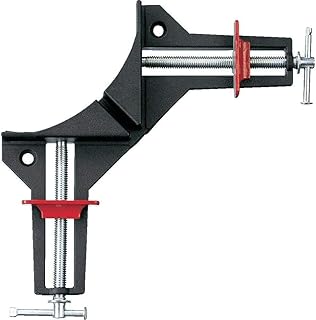 | Armor Tool 90° Corner Clamp (AC90) | Holding box corners during screw assembly (pocket-hole style builds) | Integrated clamp mechanism that pulls parts into a right-angle corner | View on Amazon |
 | Kreg KKS1020 Right Angle Clamp | One-handed alignment for face frames and cabinet corners | Swiveling clamp pad + pin that registers in a pocket hole or drilled hole | View on Amazon |
1) Woodpeckers Clamping Square Plus — Best overall for 90° assembly work (most DIY + woodworking)
A rigid, clamp-friendly 90° square that makes box and frame assembly faster and more repeatable.
Watch for: Use two clamps when possible (one to hold the square, one to pull the joint tight) so nothing creeps during glue-up.
Best for: cabinet boxes, drawers, face frames, and general right-angle assembly
What you’ll like: strong registration on both faces with built-in clamping points for quick setups
🧐 Quick verdict: The most “grab it and go” choice for keeping corners square while you clamp and fasten.
| Pros ✅ | Cons ⚠️ |
|---|---|
| ✅ Rigid body helps the corner stay at a true 90° while clamps tighten | ⚠️ Like any square, it needs clean reference edges (flush your parts first) |
| ✅ Clamp-friendly design makes it easier to actually use on every assembly | |
| ✅ Great for repeatable cabinet/drawer work and shop jigs |
Why it’s a top pick: For most assemblies, you don’t need a complicated clamp system. Instead, you need a square that registers fast and doesn’t flex when clamp pressure increases. This style keeps the corner true while you get fasteners in.
Decision bullets
- Best use: right-angle box corners, drawer boxes, cabinet carcasses, and shop fixtures.
- How it stays square: rigid 90° body + solid registration on both faces; clamp points help prevent twist while you tighten.
- Clamp clearance: designed so you can still get a bar clamp/F-style clamp where it needs to go.
- Workholding reality: clamp the square to one workpiece first, then bring the second piece in and clamp the joint.
- Best for: Anyone who wants straighter, faster assembly without constantly re-checking diagonals.
Shop tip: If parts slip during glue-up, add 120–150 grit sandpaper offcuts between the clamp pad and the work (or use grippy clamp pads). It reduces creep without over-tightening.
2) Rockler Clamping Miter Square — Best for mitered frames + clean clamp access
When you’re building frames, miters are where corners love to slide. This helps keep the joint aligned while you clamp.
Watch for: Dry-fit first. If the miter faces aren’t flat, no square will “force” a perfect seam.
Best for: picture frames, trim frames, and mitered boxes
What you’ll like: clamp clearance around the joint so you can apply pressure where it counts
🧐 Quick verdict: The easiest way to keep a mitered corner aligned while you tighten clamps and check the seam.
| Pros ✅ | Cons ⚠️ |
|---|---|
| ✅ Helps keep miters aligned while you clamp (less “skating”) | ⚠️ More specialized than a standard 90° clamping square |
| ✅ Better access for clamps on small frames | |
| ✅ Useful for trim and frame glue-ups where hands feel “one clamp short” |
Miters are a different problem than square butt joints. You’re trying to keep two angled faces in contact while clamps pull from awkward directions. A miter-focused clamping square keeps the corner aligned long enough to place band clamps, corner clamps, or brad nails.
Why it’s a top pick: It’s about access and control. It keeps the corner from drifting, but it still leaves room for clamps and fasteners.
Decision bullets
- Best use: mitered frames, trim assemblies, and light miter box work.
- How it helps: provides a consistent corner reference so the joint doesn’t shift as clamp pressure increases.
- Clamp strategy: use it as a third hand—align the corner, then apply your main clamp(s) to close the seam.
- Best for: Anyone doing frames who’s tired of chasing alignment during glue-up.
3) Milescraft 8406 ClampSquare — Best budget-first choice (occasional assembly, still a big upgrade)
A straightforward right-angle clamping square that’s easy to position for quick boxes and frames.
Watch for: Don’t over-torque clamps. Use just enough pressure to hold alignment, then fasten.
Best for: basic 90° assembly tasks, small projects, and shop repairs
What you’ll like: simple setup that improves squareness without a big learning curve
🧐 Quick verdict: A solid “first” corner clamping square for assembly if you want better corners without overthinking it.
| Pros ✅ | Cons ⚠️ |
|---|---|
| ✅ Easy way to keep a corner at 90° while you clamp and fasten | ⚠️ Less rigid than heavier clamping squares if you really crank down clamps |
| ✅ Simple to learn and quick to set in place | |
| ✅ Handy for small boxes, shop jigs, and repairs |
If you only do occasional glue-ups (or you’re building shop storage where “square enough” is fine), a budget clamping square is still a big step up. It replaces the “hold it by hand while tightening” struggle.
Why it’s a top pick: It’s the simplest way to get into guided 90° assembly. You build good habits: register, clamp lightly, verify, then fasten.
Decision bullets
- Best use: small boxes, basic frames, utility cabinets, and shop jigs.
- How it stays square: the L-shape provides a 90° reference, but your clamp setup keeps it from shifting.
- Clamp strategy: clamp the square first, then clamp the joint. If you only use one clamp, the square can rotate.
- Best for: corner clamping square for assembly for beginners who want a practical starter tool.
Quick win: Mark a reference face on every part (pencil “R”). Then always register your square on that same face, so small thickness variations don’t stack up.
4) Armor Tool 90° Corner Clamp (AC90) — Best for screw assembly (fast alignment on boxes)
Great when you’re assembling boxes with screws and you want the corner held tight and square while you drive fasteners.
Watch for: Pre-drill when needed. Forcing screws can still pull a corner out of square.
Best for: cabinet boxes, utility builds, and pocket-hole-style assembly workflows
What you’ll like: a clamp that “becomes the corner,” so alignment is faster than juggling separate squares and clamps
🧐 Quick verdict: Best when you want speed—hold the corner, drive the screw, move to the next joint.
| Pros ✅ | Cons ⚠️ |
|---|---|
| ✅ Fast corner alignment for screw-driven assemblies | ⚠️ Not as flexible as clamping squares for varied clamp setups |
| ✅ Holds parts in position while you drill/drive | ⚠️ Best results require consistent part thickness and good edge prep |
| ✅ Good for repeatable box-building workflows |
If you build a lot of shop cabinets, garage storage, or utility boxes, a corner clamp that holds the joint while you drill and drive is a time saver. It cuts the “hold it, clamp it, re-check it” loop.
Why it’s a top pick: It matches how many DIYers actually assemble. You align the corner, drive fasteners, and repeat. The clamp does the holding while your hands run the drill/driver.
Decision bullets
- Best use: screw-driven box corners and quick assembly work.
- How it stays square: the clamp body provides the 90° corner reference while it squeezes both parts.
- Fastener tip: if screws pull the corner out, your pilot hole is off or the screw is too aggressive—so pre-drill and reduce drive torque.
- Best for: fast, repeatable corner alignment when you’re building multiple boxes.
Learn the setup: [GUIDE:/how-to-choose-corner-clamping-square-for-assembly/|how to choose a corner clamping square for assembly]
5) Kreg KKS1020 Right Angle Clamp — Best for one-handed alignment (face frames + pocket-hole builds)
A practical clamp for keeping two parts aligned at 90° while you drive screws—especially handy in pocket-hole workflows.
Watch for: Keep the reference faces flush. The clamp holds position, but it won’t automatically fix a proud edge.
Best for: face frames, cabinet corners, and right-angle joints where you want one-handed control
What you’ll like: registration pin option makes it easy to keep parts aligned while you fasten
🧐 Quick verdict: Best when you want a simple clamp that holds 90° while you drill/drive—especially on face frames.
| Pros ✅ | Cons ⚠️ |
|---|---|
| ✅ Great for holding alignment while you fasten (acts like a third hand) | ⚠️ Not a substitute for a rigid corner square when you need a large reference |
| ✅ Works well for face frames and cabinet corner work | ⚠️ You still need to check for flush faces before tightening |
| ✅ Quick to move from joint to joint |
This is the clamp-style approach. Instead of clamping a square to the work, you use a right-angle clamp to hold the joint while you drill/drive. It’s especially useful for face frames and cabinet corners because it frees up your hands for the driver.
Why it’s a top pick: It’s fast. For many DIY builds, speed plus “consistently square” beats fussing with multiple clamps and constant re-checking.
Decision bullets
- Best use: face frames, cabinet corners, and right-angle joints where you’re driving screws.
- How it stays square: the clamp geometry holds the two parts at 90° while you fasten.
- Flush matters: check the outside faces with your fingertips before tightening, because tiny steps become big headaches later.
- Best for: quick alignment for screw-based assembly workflows.
For layout and verification tools that pair well with assembly work: [MONEY:/best-setup-square-set-for-joinery-layout/|best setup square set for joinery layout]
How we choose
To recommend corner squares that actually help at the bench, we focus on what changes results during clamp-up:
- Rigidity (flex turns into out-of-square corners)
- Registration (how easily it sits tight to both faces)
- Clamp clearance (if you can’t get clamps/driver access, it won’t get used)
- Repeatability (easy to move from corner to corner without re-inventing the setup)
- Real-world workflows (glue + clamps, brads, screws, pocket-hole builds)
Don’t buy the wrong corner clamping square for assembly
Don’t buy this if…
- You expect a corner square to fix warped parts or badly cut ends. It can hold alignment, but it can’t make an out-of-flat board behave.
- You need a precision layout square for joinery marking. Assembly squares help hold parts, but layout squares help you mark. (Related: [GUIDE:/how-to-choose-setup-square-set-for-joinery-layout/|how to choose a setup square set for joinery layout])
- You won’t clamp the work. Any corner clamping square for assembly works best when the parts are held so they can’t creep as pressure increases.
Buy this if…
- You’re building boxes, drawers, and frames and want repeatable 90° corners with less re-checking.
- You do glue-ups and want a corner held square while you place clamps and add fasteners.
- You want a corner clamping square for assembly for beginners that makes “square” feel achievable without a complicated clamp collection.
Corner clamping square for assembly buying guide: how to choose the right one
Two main approaches: clamp-on squares vs corner clamps
Most options fall into two camps:
- Clamping squares (L-squares)
They register on the outside faces of the corner. You clamp the square to the work, then clamp the joint. Great for boxes, drawers, and cabinet work. - Right-angle corner clamps
They act like the corner itself and hold the joint while you drill/drive. Great for face frames and screw assembly where you want speed.
If you want a step-by-step chooser, use this: [GUIDE:/how-to-choose-corner-clamping-square-for-assembly/|how to choose a corner clamping square for assembly]
Size matters: match the square to your typical work
Corner squares are usually described by leg length (like 4″ or 6″). Pick based on what you assemble most:
- Small parts: shorter legs are easier to fit around clamps and hardware.
- Cabinet/drawer work: longer legs give better leverage and make it easier to see if faces are flush.
- Thicker builds: check the tool’s clearance so it can sit flat on 3/4″ (19mm) stock without rocking.
What “stays square” really means (rigidity + clamp plan)
A corner clamping square stays accurate because of two things:
- Rigidity: if the tool flexes when you tighten clamps, the corner moves.
- Clamp plan: if you only clamp one side, the square can rotate. Two clamps (or a clamp + stop block) is often the difference between “looks fine” and “stays fine.”
Quick accuracy check (1 minute)
- Dry-fit two scraps into an L shape.
- Clamp your square in place, then add your main clamp across the joint.
- Check inside and outside with a small square. If it shifts, improve registration (flush faces) or change your clamp plan.
Glue-up reality: creep, flush faces, and clamp pads
Most “out of square” corners happen during tightening. Two practical rules help immediately:
- Get faces flush first, then tighten. If one face is proud, clamp pressure often locks it in wrong.
- Control creep: clamp pads and grippy surfaces help. If parts slide, back off pressure and add a second clamp or a stop.
If you’re also dialing in layout tools for joinery and machine setup, this pairs well: [GUIDE:/how-to-choose-setup-square-set-for-joinery-layout/|how to choose a setup square set for joinery layout]
Troubleshooting table: problem → cause → fix
| Problem you see | Likely cause | Fix that works in a real shop |
|---|---|---|
| Corner looks square, then racks when you tighten clamps | Only one clamp; square rotated; parts crept on glue | Clamp the square to one piece first, then clamp the joint; add a second clamp or a stop block |
| Outside is square but faces aren’t flush | Parts shifted vertically during tightening | Use a second clamp to pull faces flush, or clamp to a flat caul/carrier board before final tightening |
| Box diagonals don’t match | Assembly racked; uneven clamp pressure | Measure diagonals, then “pull” the long diagonal shorter with a clamp; re-check before fastening |
| Miter joint slides while clamping | Clamp pressure on angled faces causes skating | Use a miter clamping square; reduce clamp pressure and add a band clamp; pin with brads if appropriate |
| Square rocks and won’t sit flat | Sawdust, glue squeeze-out, or damaged reference edge | Clean the reference faces; scrape squeeze-out; verify the workpiece edge is straight/flat |
| Screws pull the corner out of square | Pilot hole off; over-driving; screw acting like a wedge | Pre-drill properly, reduce driver torque, and keep the corner clamped until the fastener is seated |
| Small parts are impossible to clamp square | Not enough clamp clearance; parts tipping | Clamp parts to a larger carrier board so the square and clamps have a stable surface |
| Repeat corners aren’t consistent | Inconsistent reference face/edge | Mark a reference face and always register the tool from the same face |
For a deeper chooser (with examples and setups): [GUIDE:/how-to-choose-corner-clamping-square-for-assembly/|corner clamping square for assembly buying guide]
Common mistakes and quick wins (shop-pro tips)
Quick wins that instantly improve square corners
- Dry-fit first and confirm the corner closes before glue enters the chat.
- Use two clamps: one to hold the square, one to close the joint.
- Check diagonals on boxes. It’s the fastest “is it racked?” test.
- Clamp to a carrier board for small parts so nothing tips while you tighten.
Common mistakes
- Over-tightening clamps and causing the corner to creep on glue.
- Registering from random faces (one corner from the “good” face, the next from the opposite face).
- Trying to assemble out-of-square parts and blaming the tool.
If you’re also building out your layout kit, see: [MONEY:/best-setup-square-set-for-joinery-layout/|best setup square set for joinery layout]
FAQs
1) What’s the best corner clamping square for assembly?
For most DIY and woodworking, a rigid clamp-on 90° square is the most useful choice. It registers quickly on two faces, so it stays put while you tighten clamps and add fasteners.
2) Do I need one or two corner clamping squares?
One works for many tasks, but two makes box assembly faster because you can hold both ends of a corner (or two corners) while you clamp and fasten. If you build cabinets or drawers often, two is a practical upgrade.
3) Is a corner clamp the same as a corner clamping square?
Not exactly. A clamping square is a rigid 90° reference you clamp to the work. A corner clamp is a clamp that holds the corner at 90°. Many shops use both, depending on the job.
4) Why do my corners go out of square during glue-up?
Usually it’s creep. Clamp pressure makes parts slide on wet glue, or the square rotates because it’s only clamped on one side. Use a second clamp, reduce clamp force, and clamp the square to one piece before closing the joint.
5) What size corner clamping square should I buy?
Match it to your typical work. Shorter squares are easier on small parts, but longer squares give better leverage and visibility on cabinet and drawer work. If you mostly build with 3/4″ (19mm) stock, make sure the square sits flat and gives clamp clearance.
6) Can I use a corner clamping square for face frames?
Yes. Many people prefer a right-angle clamp for face frames because it holds the joint while you drill/drive, but a clamping square works well too if you have a solid clamp plan and enough clearance.
7) What’s the fastest way to check if a box is square?
Measure diagonals corner-to-corner. If they match, the box is square. If not, pull the long diagonal shorter with a clamp, then re-check before fastening.
8) Do I still need a setup square set if I have clamping squares?
They solve different problems. Clamping squares help hold parts during assembly. Setup squares help with layout and machine setup. If you do joinery and layout work, a setup set is still useful: [GUIDE:/how-to-choose-setup-square-set-for-joinery-layout/|setup square set guide]
9) What’s a good beginner approach to using a corner clamping square for assembly?
Start with a dry-fit, mark a reference face, clamp the square to one piece, bring the second piece in, then clamp the joint. Verify with a small square or diagonals, then fasten.
Conclusion: which corner clamping square should you buy?
If you want the most useful “first” tool, start with a rigid clamping square like Pick #1. It’s the most versatile for cabinet boxes, drawers, and general assembly.
If you build frames with miters, Pick #2 is the specialized helper that keeps corners aligned while clamps tighten.
On a tight budget, Pick #3 still improves your results a lot, but you’ll want a good clamp plan.
If your workflow is screw-based box building, Pick #4 is the speed pick.
And for face frames and quick one-handed alignment, Pick #5 is a practical clamp you’ll reach for constantly.
Next step: use the step-by-step selector here: [GUIDE:/how-to-choose-corner-clamping-square-for-assembly/|corner clamping square for assembly buying guide]